BLDC Fans are known for their energy efficiency, quiet operation, ease of use, plus convenient remote-control features. Compared with traditional ceiling fans BLDC Fans are designed to provide efficient airflow at lower levels of electricity usage. Yet, like any electrical appliance a BLDC Fan can develop problems over time.
Many basic issues can often be resolved by performing simple checks and/or regular maintenance. However, issues involving the motor, controller, receiver, wiring, or internal electrical components should be handled by qualified electricians or technicians. Knowing when to seek professional service can help to ensure that your fan, your home, and its contents remain safe.
Below you will find a list of the most common BLDC Fan situations when your fan may need professional servicing.
1. Fan Not Starting
One of the clearest indicators that a BLDC Fan may need professional service is if it does not work/start at all. Prior to calling a technician you can perform a few simple checks to rule out some common causes.
Ensure that the main power supply is on, check that the remote-control batteries are working, and confirm that the fan is not turned off via the remote-control.
If the above checks do not resolve the problem, the fan receiver, controller, wiring, or motor may be at fault.
Do not attempt to open the fan and inspect/repair the motor or wiring. A BLDC Fan involves various electrical components which should only be professionally serviced. If the fan still fails to start, a trained electrician or authorise service technician should be contacted.
2. Fan Running Slower Than Usual
A BLDC Fan is designed to provide efficient airflow, with consistent speeds at each level. If you notice that your fan is suddenly running slower than usual it is advised that you investigate the cause.
The first check is to confirm the speed level selected on your remote-control. The fan may be set at a lower speed than you are expecting. Another simple check is to inspect the fan blades for excessive dust.
If the fan still appears to be running slow try adjusting the speed level up and then back down again. If this fails to resolve the issue the fan controller, motor, power supply, or another component may be at fault. If this is the case avoid repeatedly switching the fan on and off, and have it professionally serviced or inspected.
3. Fan Making Unusual Noises
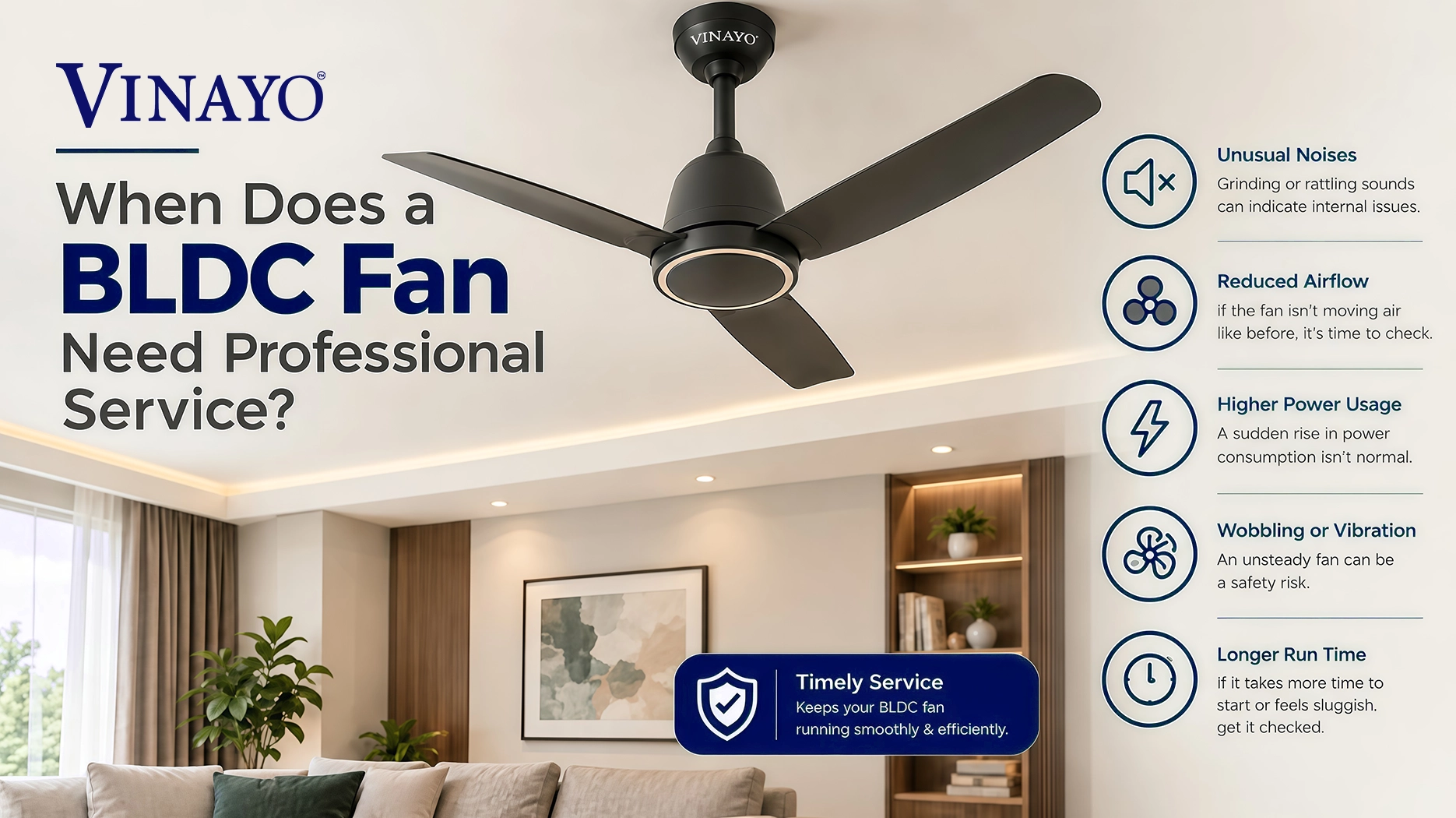
When installed and operating correctly a BLDC Fan should make few, if any unusual noises. If you suddenly hear clicking, rattling, grinding, buzzing, humming, or other unusual sounds coming from your fan it is important not to ignore the issue. In some cases the cause of unusual noises can be easily identified. For example dust, a loose external item, or even a foreign object may become lodged in or around the blades. You can easily switch the fan off and conduct a visual inspection.
However, if the unusual noise persists after a basic cleaning and inspection the cause may be something more serious such as a loose fitting, bearing, blades, or motor. Do not attempt to dismantle the motor housing in order to investigate the potential cause of unusual noises. Contact a qualified technician to have the fan inspected.
4. The Fan Is Wobbling Excessively
When installed correctly a BLDC Fan should only wobble slightly if at all. A fan that wobbles noticeably from side to side may have been installed incorrectly, or have a number of other issues. These issues can range from loose fittings, an improperly installed down rod, unbalanced blades, or another mechanical problem. Excessive wobbling places unnecessary strain on the fan’s mounting hardware and other components.
Try switching the fan off and tightening any external fittings that may be loose. If this does not resolve excessive wobbling, a qualified technician or electrician should be contacted. Excessive wobbling is a serious issue and should not be ignored.
5. Motor or Fan Heating Up Excessively
It is not uncommon for a fan to heat up slightly during extended use. However, the motor area of a BLDC Fan should not become excessively hot under any circumstances. If the fan motor area is becoming excessively hot, and is emitting unusual odours, noises, changes in speed, or ceasing to operate altogether it must be switched off.
Excessive heating may be caused by an electrical fault, controller or motor issues, or restricted airflow around the motor area. Do not operate the fan in an attempt to confirm that the suspected issue is indeed the cause.
Switch the fan off and allow it to cool. If the suspected issue reoccurs, contact a certified electrician or authorise service technician.
6. Fan Stopping All of a Sudden
Does your fan start but then stop unexpectedly while running? While it is not uncommon for a fan to stop unexpectedly due to a power-cut, remote-control failure, or built-in circuit-breaker depending on the model, it should not occur repeatedly.
If your fan is stopping unexpectedly the cause could be the controller, receiver, motor, power supply, or another electrical component.
The first step is to check the main power supply and remote-control batteries. If this fails to resolve the suspected issue have the fan professionally serviced or inspected. Do not attempt to repeatedly switch the fan on if it stops unexpectedly, as this can exacerbate the suspected issue.
7. Remote Control Not Working
As most BLDC Fans are controlled primarily with a remote-control, a faulty remote-control can cause a number of issues. Try replacing the remote-control batteries with fresh batteries and ensure that the remote is working correctly. If the remote-control fails to operate the fan it may need to be replaced.
In some cases a faulty remote-control can cause issues with the receiver or the fan’s internal communication system. A qualified technician can identify whether the remote-control needs to be replaced, or whether the receiver requires attention. Avoid opening the receiver housing if you are unfamiliar with electrical components.
8. Fan Speed Fluctuating Frequently
If you notice that your fan speed is frequently fluctuating without your input it is important to investigate the suspected issue. Fluctuating speeds can be caused by a number of issues ranging from an unstable power supply, remote-control failure, controller failure, or an internal electrical fault.
The first step is to check the power supply, and remote-control. If the fan speed regularly fluctuates despite having a stable power supply, and a working remote-control it must be professionally serviced or inspected. A technician can investigate the suspected issue and advise accordingly.
9. Burning Smell, Smoke, or Sparks
A burning smell, visible sparks, smoke, or damaged wiring should always be treated as a serious fault. If you notice any of these issues it is important to switch the fan off immediately. If it is safe to do so, disconnect the main power supply to the fan.
Never attempt to continue operating or testing the fan to see if the suspected issue resolves itself. These types of faults are often caused by an electrical fault within the fan, or damaged wiring. Never attempt to repair damaged wiring unless you are a qualified electrician. Contact a certified electrician or authorise service technician as soon as possible.
10. Lower Airflow Than Usual
A reduction in airflow does not always mean that a BLDC Fan has developed a serious issue. One of the most common reasons for a reduction in airflow is dust build-up on the fan blades. Switch the fan off, and clean the blades.
Another simple check is to ensure that the fan speed has not been reduced accidentally, and that there are not any visible obstructions restricting normal airflow. If you have performed a basic inspection and the suspected issue persists, have the fan professionally serviced or inspected.
A reduction in the amount of airflow can be caused by a number of issues including a faulty motor, unbalanced blades, improper installation, or another suspected issue. A qualified technician can identify the suspected cause and advise accordingly.
11. Problems After a Power Fluctuation
Power fluctuations can affect a number of electrical appliances including BLDC Fans. After a severe power fluctuation you may notice that your fan is not working correctly. This can manifest in a number of ways including failure to start, fluctuating speeds, unexpected stops, unusual noises, or remote-control failure.
If your fan is working incorrectly after a power fluctuation avoid repeatedly switching it on to see if the suspected issue resolves itself. Switch the fan off and have it professionally serviced or inspected. If you notice burning smells, unusual heating, sparks, or other unusual activity it is best to avoid operating the fan altogether. A certified electrician or authorise service technician can identify the suspected cause and advise accordingly.
12. When Regular Maintenance Is No Longer Enough
Regular cleaning and maintenance can often resolve simple issues, but there comes a point when a fan needs to be professionally serviced or inspected. If you have performed regular maintenance and the suspected issue persists it is best to leave the fan alone and have it professionally serviced or inspected by a qualified technician. Issues involving the motor, controller, receiver, wiring, mounting hardware, or other internal components should always be left to a professional.
Attempting to inspect or repair internal components can pose an electrical hazard, and can also damage components which could have been easily replaced.
What Can You Safely Check Before Calling a Technician?
Before contacting a professional it is always a good idea to perform a few simple checks.
You should always check that the main power supply is on, replace remote-control batteries if required, confirm that the fan speed has not been reduced, clean visible dust from the blades, and inspect the fan for any external obstructions.
Other checks that you can perform are; looking for any visible signs of damage (without opening the fan), unusual smells, unusual noises, sparks, and unusual heating. If these simple checks do not resolve the suspected issue avoid opening the fan and contact a qualified technician.
How Often Should a BLDC Fan Be Serviced?
There are no hard and fast rules regarding how often a BLDC Fan should be serviced. How often a fan should be serviced will be determined by the model you own, and the local climate that you live in.
As a rule of thumb, you should keep the blades reasonably clean, and inspect the fan for unusual noises, excessive wobbling, or a reduction in airflow on a regular basis.
Professional servicing is not usually required on a regular basis, but it is important to arrange for professional servicing or inspection if the suspected issue cannot be resolved. Always refer to your fan’s user manual or the manufacturer’s website for more information.
Why Is Professional Service Better Than DIY Repair?
BLDC Fans are different from traditional fans in that they incorporate a number of electrical components including a controller and receiver in addition to the motor.
Opening a fan without the correct tools and knowledge can expose you to an electrical hazard, and can also damage internal components.
Qualified technicians are trained and equipped with the correct tools to inspect the controller, receiver, motor, wiring, mounting hardware, and other components of a BLDC Fan. Professional servicing can also help to identify the root-cause of a suspected issue, rather than simply replacing parts.
How to Reduce the Need for Professional Repairs
While you cannot avoid all electrical issues entirely, there are steps that you can take in order to reduce the need for professional repairs.
A few simple steps can go a long way including; cleaning the blades on a regular basis, avoiding operating a fan which is excessively wobbling, ignoring unusual noises, replacing remote-control batteries when required, keeping the fan clear of any external obstructions, avoiding operating a fan which is sparking or emitting burning smells, avoiding DIY repairs involving electrical components, following the manufacturers’ installation and maintenance guidelines, and getting unusual issues resolved as soon as possible rather than waiting until the fan stops working.
Final Thoughts
A BLDC Fan is ideal for providing years of reliable, energy efficient airflow. However, like any electrical appliance it can develop mechanical or electrical issues over time.
Unusual noises, excessive wobbling, slow operation, unexpected stops, fluctuating speed, excessive heating, low airflow, burning smells, or sparks should never be ignored.
Before contacting a professional it is a good idea to perform some simple checks such as confirming that the main power supply is on, replacing remote-control batteries if required, cleaning the blades, and confirming the fan speed has not been reduced accidentally.
However, if the suspected issue involves the motor, controller, receiver, wiring, or other internal electrical components a professional should be contacted.
The safest option is to simply switch the fan off if you suspect that something is wrong, and contact a qualified technician. With regular cleaning, plus professional servicing or inspection when required a BLDC Fan can continue to provide efficient, reliable airflow for many years.
Frequently Asked Questions
Find answers to common questions about your BLDC fan.