
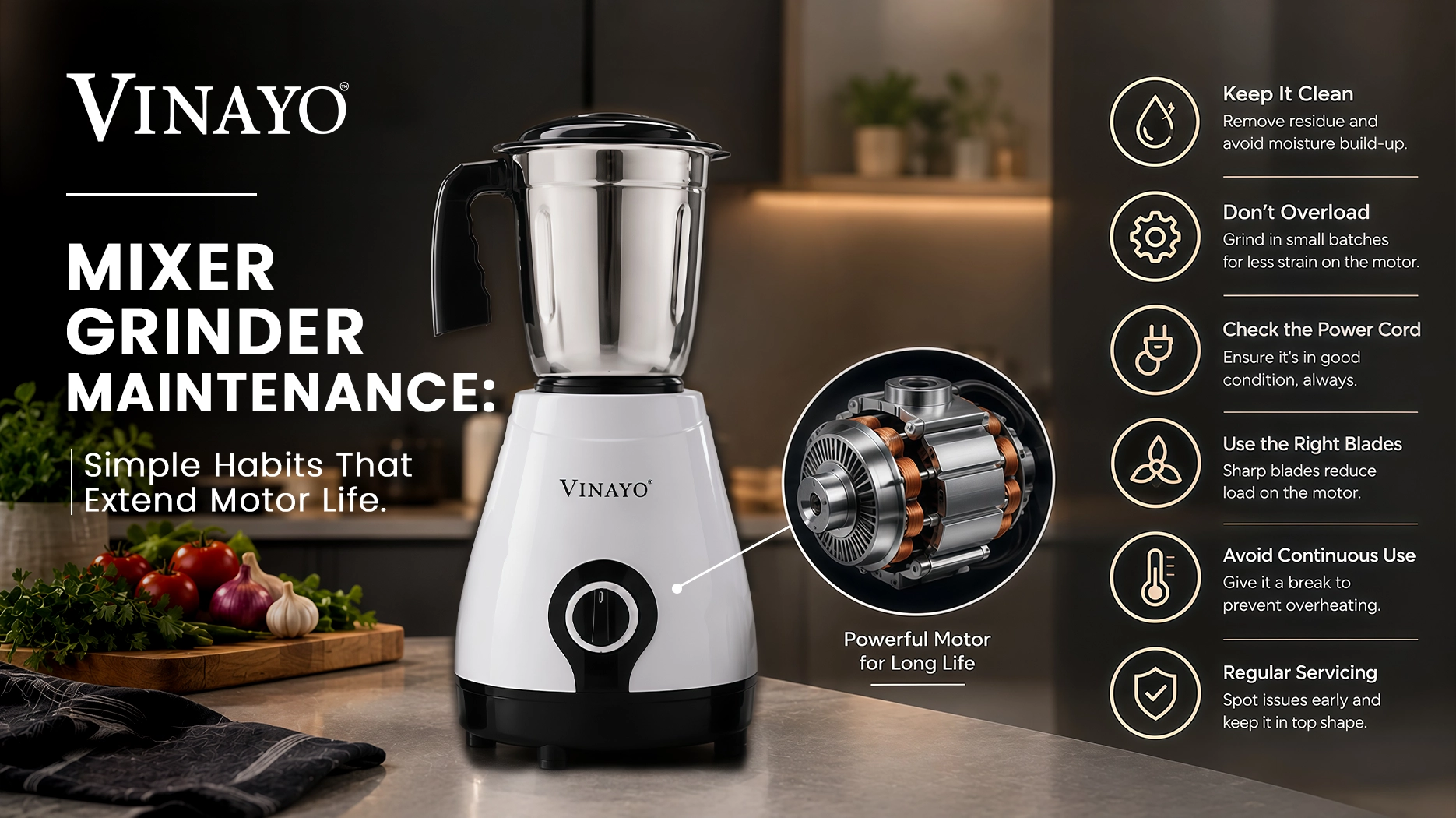
A mixer grinder holds pride of place in an Indian kitchen. From grinding chutneys, spices, masalas, making smoothies and batters, the mixer grinder does it all. And more often than not, it does it everyday. Which means that your mixer grinder needs regular maintenance in order to keep working as efficiently as possible.
In fact, a lot of mixer grinder problems do not arise suddenly. They are the result of our using the appliance incorrectly, overloading it, leaving it to run dry, not taking care of the jars, and other similar habits. These bad habits combine to put unnecessary strain on the motor, which shortens its life. But there is good news: like most home appliances, mixer grinders do not require any special maintenance. Just a few simple habits will keep the motor, blades, jars and seals in great condition, and help your mixer grinder last much longer.
Here are some things you can do to take care of your mixer grinder.
1. Do Not Run the Motor for Long Periods
One thing most people tend to do with their mixer grinder is run the motor for too long at a stretch. Mixer grinder motors are made to be strong and powerful, but that does not mean they can run for hours on end. Mixer grinders should be used in short bursts of 1-2 minutes (or as specified in the user manual), with breaks in-between. If you are making something that requires a longer continuous run, switch the mixer off and let it cool down before continuing.
This is especially important if you are grinding something thick or hard like whole spices, nuts, dry masalas, hard vegetables and dense batters and pastes.
Why this helps
Running the motor for an extended period of time will cause it to overheat. By letting it rest in between, you let it cool down, reducing the strain on it. A short burst of power is enough to grind most things, so there is no point in running it longer than necessary.
A simple 1 minute on, 30 seconds off, 1 minute on, etc. cycle can help you get excellent results while also not overworking your mixer grinder.
2. Do not Grind Hot Mixtures
Another common bad habit is putting boiling-hot food in the mixer jar and running it on high speed.
Hot liquids can build up pressure in a closed jar, especially if the mixture is bubbling or steaming. This will result in the mixture shooting out when you release the lid, and may even damage the jar or motor due to the excessive pressure.
If you have hot food you want to grind, let it cool a little before putting it in the jar. Also make sure not to fill the jar completely always leave some space at the top so that the hot liquid does not shoot up when you open the lid.
Some good examples of hot mixtures are tomato gravies which have been boiled, soups, and similar hot liquid dishes.
Why this helps
Putting hot liquid into a sealed jar and running it at high speed will cause the mixture to expand and shoot outwards forcefully when the jar is opened. This will put unnecessary strain on the motor, and it can also result in a very hot, messy mess all over your kitchen.
By simply letting the mixture cool a little before grinding, you can avoid this problem altogether.
3. Clean the Mixer Grinder Jar Straight After Use
One of the easiest things you can do to maintain your mixer grinder is to clean the jar right after you have used it. Chutney, masala, batter and other mixtures stick to the inside of the jar, and if you leave them to dry, they will harden and be much more difficult to clean off.
So after you have used your mixer grinder, wash the jar thoroughly as soon as possible. To make cleaning easier, you can add a little warm water and mild dish soap to the jar, close it, and run it for a short period of time according to the user manual. Then empty and rinse it again.
Why this helps
Cleaning the jar after every use will reduce the chances of food particles sticking to it, which causes bad odours and stains. It also keeps the blade sharp and free of residue, and ensures that no old food particles mix with new food when you use the mixer again. Overall, it makes the jar much more hygienic and easier to clean next time.
Make sure to clean the bottom and edges of the lid as well, where food particles tend to get stuck.
4. Do not Overload the Mixer Grinder Jar
When we overload the mixer jar, it increases the workload on the motor. This causes it to overheat, and reduces its life. A good way to avoid this is to make sure that you do not fill the jar completely.
Especially when grinding thick or dense mixtures, it is a good idea to process the mixture in instalments, so that the motor does not have to run continuously for long periods of time. Grinding small amounts takes more time, but is less taxing on the motor. It is also a good idea to stop the mixer in between to check the consistency of what you are grinding.
Why this helps
Loading the jar completely or overfilling it prevents the mixture from moving freely inside the jar. This causes the motor to work harder and run hotter, which reduces its life. It also causes leakage and spillage. By grinding in smaller quantities and allowing the mixture to move freely inside the jar, you reduce the workload on the motor and ensure better grinding results.
5. Check the Rubber Gasket Regularly
The rubber gasket or ring on the lid of the jar is important in that it keeps the liquid and semi-liquid mixtures from spilling out when the mixer is in use.
As it is used repeatedly, the gasket can dry out, crack, chip or wear off, and it will need to be replaced. If you want to extend the life of your gasket, you should check it regularly and replace it if you see any signs of damage.
Some things that can go wrong with a gasket are:
- Cracks
- Cuts
- Deformation
- Hardness
- Looseness
- Any other sign of damage or wear
When using the mixer, if you notice liquid dripping from the jar, this may indicate a faulty gasket. If you suspect that the gasket is damaged, stop using the mixer, and either replace or repair the gasket as necessary. A damaged gasket can lead to leakage and spillage, so it is important to get it fixed as soon as possible.
6. Take Care when Cleaning the Mixer Grinder Blades
The blades are the part that actually does the grinding, and therefore requires the most care. Make sure that you do not put your fingers near the blades while you are cleaning them, even if the mixer is turned off. Always unplug the mixer before attempting to remove or clean the blades.
To clean the blades, use a soft brush or suitable cleaning tool and gently brush away any food particles clinging to the blades. Do not use a hard brush or other abrasive objects, as this can damage the blades or the jar.
Why this helps
The blades are the most dangerous part of the mixer grinder, as they are sharp and can cut you if you are not careful. Always make sure that the mixer is turned off and unplugged before you attempt to clean the blades or remove them from the jar.
7. Make sure the Motor Base is Dry Before Using
Wiping the motor base with a damp cloth is a good way to keep the mixer grinder clean. However, this is not the best way to clean it. The base contains the electrical parts, and moisture can cause damage and possibly lead to electrical shorts.
Instead, dry the base thoroughly with a soft, dry cloth. Make sure that the bottom of the jar is also dry before you place it on the base.
Why this helps
Keeping the motor base dry will reduce the chances of it getting dirty or wet, and will also reduce the risk of electrical damage. The base should only be wiped, not soaked or washed with water. A damp cloth is all that is needed to wipe away any dust or dirt.
8. Avoid Grinding Very Hard Ingredients on the Blades
The blades of the mixer grinder are made to be strong, but you should still avoid grinding very hard ingredients on them, as this can cause them to dull, chip or break. Ingredients like whole dry spices, coffee beans and nuts are very hard, and will cause the blades to wear out faster. If your mixer grinder has a dedicated jar for dry ingredients, you should use it to grind these types of ingredients.
This will reduce the amount of wear and tear on the blades of the main jar, and will also reduce the risk of the ingredients sticking to the sides of the jar and leaving a bad odour.
Some good examples of dry ingredients are:
- Whole dry spices
- Coffee beans
- Dry masalas
- Nuts
If you are using a mixer grinder that does not have a dedicated jar for dry ingredients, you should always try to avoid putting dry and wet ingredients in the same jar.
This will reduce the risk of the dry ingredients sticking to the wet ingredients, and will also reduce the risk of the dry ingredients clogging the blades.
9. Use the Appropriate Jar for Different Types of Mixing
Most mixer grinders come with more than one jar, which can be used for mixing different types of ingredients. Using the right jar for the right type of ingredient will make grinding easier, and will also reduce the amount of wear and tear on the blades.
A good rule of thumb is to always use a smaller jar for small quantities of ingredients, and a bigger jar for larger quantities. If you are unsure which jar to use for a particular type of ingredient, you should always refer to the user manual that came with your mixer grinder.
Using the correct jar will make grinding easier, as the ingredients will be able to move around more freely.
10. Do not Ignore Any Unusual Noises Coming from the Mixer Grinder
If your mixer grinder starts to make an unusual noise, you should stop using it immediately. Make sure that the jar is not overloaded, or that there are no foreign objects inside the jar that are causing the noise. If the noise persists after you have checked these things, you should have your mixer grinder checked by a professional technician.
Unusual noises can be a sign that your mixer grinder is starting to malfunction. It is therefore important to stop using it as soon as you hear any unusual noises, and have it serviced by a professional technician.
11. Give the Motor Time to Cool Down in Between Long Runs
When using your mixer grinder, it is important to give the motor time to cool down in between long runs, especially when you are grinding thick or dense mixtures. The motor will overheat if it is used for long periods of time without a break.
This can cause it to malfunction, and in severe cases, it can shorten the life of the motor. A good rule of thumb is to let the motor run for 1-2 minutes, then take a break of 30 seconds to 1 minute, before resuming grinding.
12. Do not Run the Mixer Grinder Empty
Unless your user manual specifically says that you should, avoid running the mixer grinder empty. The blades of the mixer grinder are designed to cut and grind ingredients, and therefore they will not last as long if they are not being used. This means that you should avoid running the mixer grinder empty, unless absolutely necessary.
If you need to clean an empty mixer jar, use the cleaning procedure specified in your user manual. Do not run the mixer grinder empty as a method of cleaning it.
13. Check the Power Cord and Plug for Damage
It is important to inspect the power cord and plug of your mixer grinder on a regular basis, to make sure that there is no damage to the cord or plug. If you do notice any damage to the cord or plug, you should stop using the mixer grinder and have it repaired by a certified technician.
Never attempt to repair damaged wiring or electrical connections yourself, unless you are a qualified electrician.
When Should I Get My Mixer Grinder Serviced?
As with all electrical appliances, regular maintenance is important to ensure that your mixer grinder lasts for as long as possible. However, there are some signs that it is time to take your mixer grinder to a certified technician for service.
Some of these signs are:
The motor makes an unusual noise, or it vibrates excessively.
There is a burning smell coming from the mixer grinder.
The motor runs too hot, or it keeps shutting off due to overloading.
The blades do not move, or they are not moving smoothly.
The jar leaks, after checking and replacing the gasket.
The mixer grinder suddenly stops working.
The power cord or plug is damaged.
The mixer grinder is performing poorly, or it is not functioning as well as it used to.
Electrical appliances are prone to electrical damage and failures. It is therefore important to take your mixer grinder to a certified technician as soon as you notice any of the signs listed above.
A Simple Mixer Grinder Maintenance Routine
You do not need to spend a lot of time maintaining your mixer grinder. In fact, a simple routine can be enough to keep it running smoothly. Here is a simple maintenance routine that you can follow:
After every use:
- Turn off and unplug the mixer grinder
- Remove any food residue from the inside of the jar
- Wash the jar according to the instructions
- Wash the lid
- Check for any leakage
- Dry the jar thoroughly before storing or reassembling
A few times a month:
- Check the rubber gasket for wear and tear
- Check the blades for any damage or residue
- Wash the motor base
- Check the condition of the power cord and plug
- Check to make sure that the jar fits snugly into the motor base
During heavy use:
- Do not overload the jar
- Use short bursts of power
- Give the motor time to cool down
- Process hard or dense ingredients in instalments
- Do not ignore strange sounds or a burning smell
Why Good Maintenance Keeps Mixer Grinder Life Longer
A mixer Grinder is made up of several parts – the motor, blades, jars, seals, couplers, switches and electrical connections. If even one of these elements is damaged or worn out, it can cause the whole mixer grinder to malfunction.
For example, overloading the jar can cause the motor to work harder than it is supposed to, which can damage it. Continuous use without breaks can cause the motor to overheat, which can also damage it. A worn or broken gasket can cause the jar to leak, which can stain your kitchen and cause you to lose ingredients. Poor cleaning and maintenance can cause food residue to collect around the blades and seals, which can cause the blender to work harder and reduce its lifespan.
Good mixer grinder maintenance means preventing these issues as far as possible, as they can all be avoided. Of course, all machines will eventually start to wear out, but the better you take care of your mixer grinder, the longer it will last.
Final Thoughts
A mixer grinder is one of the most commonly used appliances in an Indian kitchen. It is used to grind spices, paste, chutney, masala, batters, and more. This means that a mixer grinder has to work much harder than other household appliances. As a result, it is a good idea to take some basic precautions to make sure that it lasts as long as possible.
Avoid running the motor for long periods of time, do not overload the jar, let the mixture cool down before you grind it, and clean the mixer jar after every use. Also, check the gasket regularly, take care when cleaning the blades, and keep the motor base dry. Finally, make sure that you use the correct jar for the right type of mixture, and do not ignore any unusual noise coming from the mixer grinder. These simple precautions will help you to get the most out of your mixer grinder.
VINAYO mixer grinders are built to last, and they are tested to ensure that they meet the highest standards of quality and performance. These simple precautions will further increase the lifespan of your VINAYO mixer grinder, and help it to deliver consistently excellent performance for many years to come.
Frequently Asked Questions
Find answers to common questions about your mixer grinder.