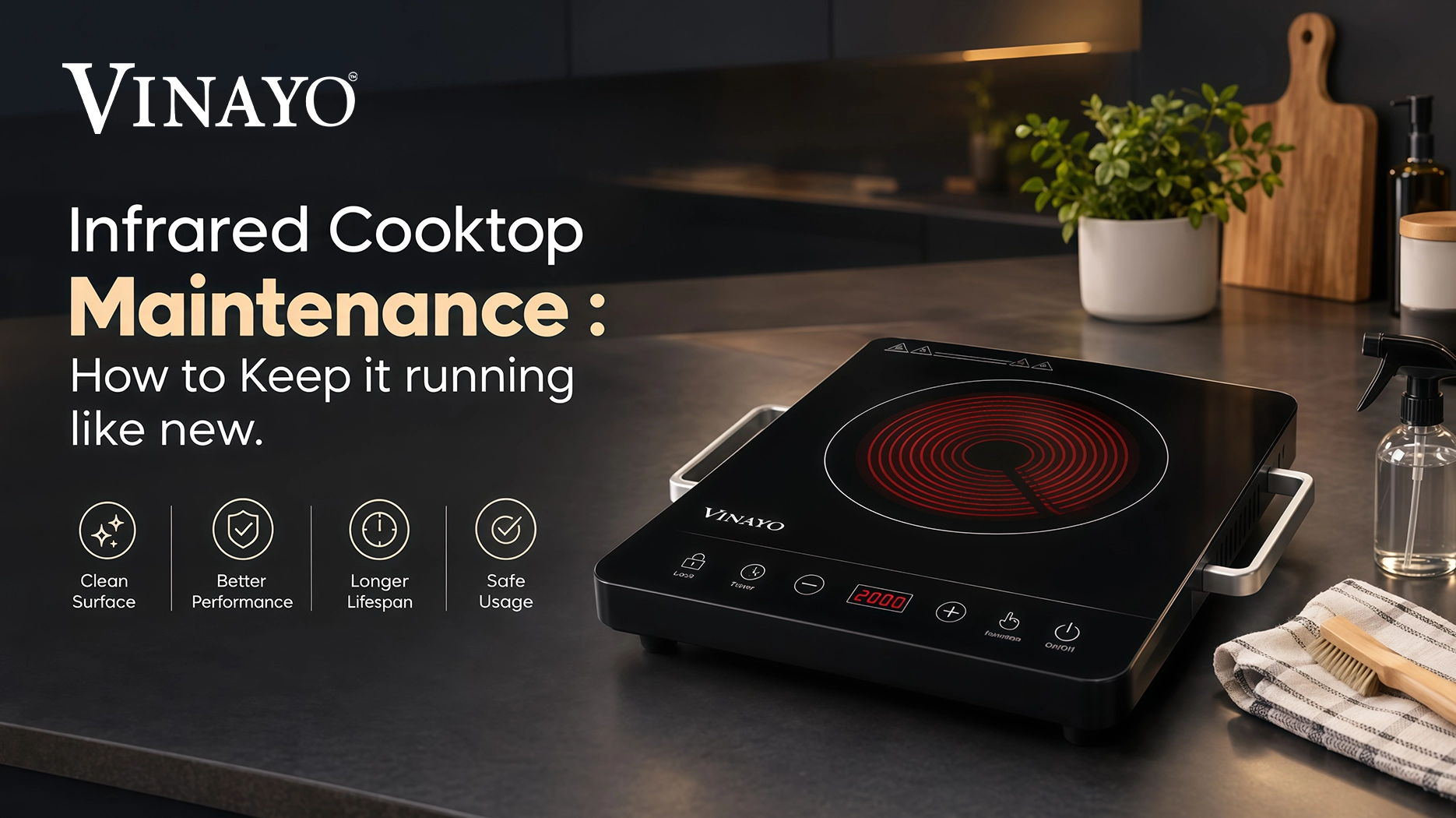
Infrared cooktop maintenance is easy because infrared cooktops are designed to be low‑maintenance. Still a few consistent habits will keep the glass surface looking new and the heating element reliable for years.
Wipe Down After Every Use
Infrared cooktops heat the surface directly. Food spills can bake on quickly. Once the surface has cooled wipe it down with a cloth and a little mild dish soap to prevent buildup.
Use a Ceramic‑Safe Cleaner for Stains
For baked‑on stains use a cleaner that is made for ceramic or glass cooktops. Avoid steel wool or abrasive pads, which can leave scratches.
Let It Cool Completely Before Cleaning
Never clean a cooktop while it is warm. Sudden temperature changes from a cloth on hot glass can cause thermal stress over time. Always wait until the surface is fully cooled.
Check Cookware Bases for Debris
Infrared cooktops work with any cookware so it is easy to place a pan with a dirty or gritty base directly on the glass. Wipe. Pan bases regularly to avoid transferring grime.
Avoid Overloading a Single Zone
Placing heavy cookware on one zone for extended periods stresses that area more than others. Rotate usage across zones on a multi‑zone model.
Keep the Ventilation Clear
Infrared cooktops rely on ventilation to manage heat. Avoid placing the unit against a wall or inside an enclosure without airflow space.
General Safety Tips
- Switch off the cooktop at the wall socket when it is not in use for long periods.
- Keep the cooktop away from direct water exposure or spills near the control panels.
- Do not touch the surface after cooking; infrared cooktops retain heat longer than induction cooktops.
- Supervise children when an infrared cooktop is active.
Storing a Portable Infrared Cooktop
If the infrared cooktop is portable store it in a flat spot away from direct sunlight and moisture. Do not pile kitchen items on top of it and keep the power cord loosely coiled rather than tightly wound.
Final Thoughts
A clean well‑maintained infrared cooktop directly affects cooking performance and appliance lifespan. Stick to this routine and the Vinayo infrared cooktop will continue delivering consistent reliable cooking for years.
Frequently Asked Questions
- What happens if I use a non-compatible utensil on an induction cooktop?
If the cookware does not have a magnetic base, the induction cooktop generally will not heat it. Most models with auto pan detection will recognise unsuitable or missing cookware and stop heating. - How much electricity does an induction cooktop consume?
Electricity consumption depends on the cooktop’s wattage, cooking time, and heat setting. A 1800W cooktop running at full power for one hour would consume up to 1.8 units (kWh), although actual consumption is usually lower because the cooktop does not operate at maximum power continuously. - When is an induction cooktop a better choice than a gas stove?
An induction cooktop can be a better choice when you want faster heating, easier cleaning, precise temperature control, and a flame-free cooking method. It is particularly convenient for modern kitchens, small spaces, and households looking for an alternative to traditional gas cooking. - How do I know which wattage is suitable for my cooking needs?
For basic cooking, boiling, reheating, and lighter everyday use, 1200–1600W can be sufficient. If you regularly prepare larger meals or want faster heating, an 1800–2000W model may be more suitable. - Can I cook all types of Indian food on an induction cooktop?
Yes, you can prepare most everyday Indian dishes, including curries, dal, rice, vegetables, tea, and frying, provided you use induction-compatible cookware. The cooking method may require some adjustment because heat is delivered differently compared with a gas stove.