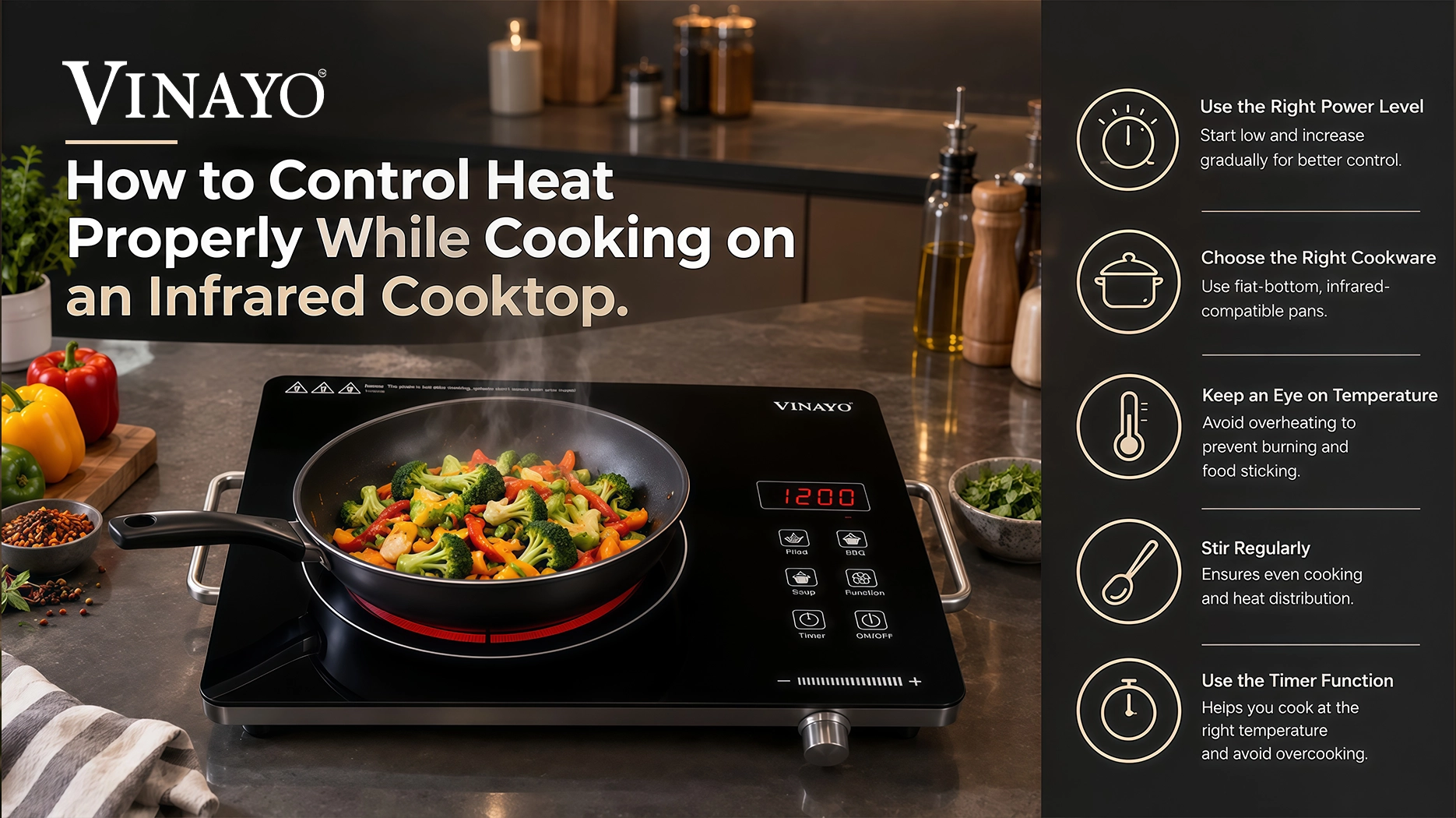
An infrared cooktop can help make everyday cooking convenient but how you control the heat can make all the difference. Unlike cooking on a gas stove where you are able to visibly see how much flame is outputting and instantly adjust the flame, an infrared cooktop has electrical heating elements beneath its heat resistant cooking surface.
Whether you are simply boiling milk, making tea, frying vegetable, cooking dal or preparing roti, understanding how to adjust power can help you to cook your food more evenly and avoid burning or over cooking your food. Knowing how to control heat is therefore an important aspect of using an infrared cooktop.
How Does Heat Control Work on an Infrared Cooktop?
An infrared cooktop has power or temperature settings that allow you to control how much heat is supplied to the cookware on the cooktop. Higher settings allow you to reach a higher temperature faster and lower settings allow you to simmer, warm up or cook slowly. The controls and power levels vary from one cooktop model to another.
Start with a Medium Heat Setting
How to avoid getting your food too hot?
- Avoid starting every dish on maximum power.
- A medium setting can help you achieve better control over the cooking of your everyday food.
- As the heat builds up, you can either increase or decrease the power being supplied depending on what you are cooking.
For Example:
Heating Water Quickly → Higher Power
Bringing Milk to a Boil → Medium to Medium-High Power
Cooking Vegetables → Medium Power
Simmering Dal or Curry → Low to Medium Power
Keeping Food Warm → Low Power
These guidelines are not set in stone and should be applied as a starting point because how long you cook, the amount of food, the type of food and the cookware can also influence the power being used.
Only Use High Heat When Building Heat
- High heat is useful when you need to rapidly heat a pan or boil water.
- But constantly keeping your cooktop on high power may end up cooking your food too fast.
- It can also cause your food to stick to the cookware, especially when you are using shallow pans where heat retention is high.
- Instead, use a higher setting until you reach the temperature you need and then reduce the power.
- This should be a good approach when boiling water – you can then reduce the power to the point where the water is boiling but not to the maximum.
Use Lower Heat for Simmering
Simmering is an important cooking technique for many dishes like Dal, Curries, Gravies, Soups, Sauces, Milk etc. After bringing the contents of the pan to the desired temperature, reduce the power to a lower setting. The idea is to gently keep your food cooking. Using lower power makes it less likely for your food to stick to the cookware and can help you to gain better control over the process of the cooking of longer meals.
Adjust the Heat Based on the Food –
How much heat should I use to cook different foods?
Water tends to be able to tolerate higher temperatures but milk can rapidly run up to a boil if you are not careful. Frying things may start off well on a moderate to high setting but you could easily burn your spices or veggies if you keep the temperature too high. Instead of using one power level for all foods, observe how your food reacts and change the power level accordingly.
Don’t Overheat Cookware While Preheating
Preheating helps certain foods but leaving empty cookware on a high setting can make it far too hot for your needs.
A simple approach would be:
- Place your pan or tawa on the infrared cooktop.
- Use a moderate power setting to warm up the cookware.
- Add the ingredients when appropriate.
- Adjust the power being supplied based on the food.
Always follow the instructions that come with your cookware.
Use Appropriate Cookware
The cookware that you use can influence how much heat is applied to your food.
Use cookware suitable for your cooktop and that has a flat base for good contact with the cooking surface.
A suitable pan or pot can be useful because it can help to spread the heat more evenly.
Always check the cooktop manufacturer’s guidelines on which cookware to use.
Don’t Keep Changing Your Heat Settings Too Much
Making changes to your heat settings is perfectly fine but constantly switching from high to low to high again can make your cooking difficult to regulate. Instead, make adjustments in a more gradual manner.
For example,
High → Medium → Low
is a more practical approach than constantly going from one extreme to the other. Once you have familiarized yourself with your infrared cooktop, you will gain a sense of what power level is right for your everyday cooking.
Use Lower Heat While Cooking Delicate Ingredients
The right power level is important when cooking with delicate ingredients like milk, chocolate, sauce, butter or certain spices. Start off on a lower or moderate setting and only increase the power level when necessary. This gives you more time to react if your food starts to get too hot.
Be Mindful of the Surface of the Infrared Cooktop
The cooking surface of an infrared cooktop is capable of being hot for long periods of time, even when the cooktop is turned off. As such, it is important to know that simply turning the cooktop off does not mean that the surface is cool. Do not touch the surface of the cooktop after use and do not let your children play on the surface until it has cooled down completely. Always follow the instructions provided by the cooktop manufacturer.
Use Appropriate Power Levels for Different Cooking Tasks
There is not a universal power level that would work for all of your cooking tasks. Your cooking method should dictate your power level.
For Boiling
Use a higher setting to rapidly heat water or other suitable liquids and reduce the setting when a vigorous boil is not necessary.
For Frying
Start on a moderate setting and adjust the power level based on the food and the cookware. Too much power can cause excessive heat.
For Sauteing
A moderate setting is usually a good start – make adjustments based on what you are cooking.
For Simmering
Use a low to moderate power level to keep your food gently cooking.
For Warming
A low power level is usually a good setting to keep your food warmed up. Do not overheat your food while trying to keep it warm.
Avoid Cooking Large Quantities of Food
The amount of food that you cook with your cooking appliance can also influence how hot your food ends up being. More food will take longer to heat but a smaller amount of food can be heated up to a boiling temperature very quickly. Instead of always choosing a higher power setting to cook a larger amount of food, give it time to heat up then adjust the power based on how your food reacts.
Learn from Observing Your Food
Observing your food can be one of the easiest ways to learn how to cook with your infrared cooktop. Pay attention to how fast your pan is heating, how fast your water is reaching a boil, whether your food is sticking, whether your oil or butter is burning, how fast your ingredients are browning, whether your dish is simmering too vigorously. With practice you will build greater awareness of which power level is appropriate for your cooking tasks.
A Simple Heat Control Routine for Everyday Cooking –
For everyday cooking you may follow this simple routine:
Step 1: Put suitable cookware on the infrared cooktop.
Step 2: Start on a moderate power setting unless your recipe specifically requires rapid heating.
Step 3: Increase the power when you need to rapidly heat your food.
Step 4: Reduce the power when your cookware has reached the desired temperature.
Step 5: Use a low power setting when simmering or keeping your food warm.
Step 6: Pay attention to your food rather than a timer.
Step 7: Turn off the infrared cooktop when your food has finished cooking and let the cooking surface cool down.
Final Thoughts
Knowing how to control heat is one of the most important aspects of cooking with an infrared cooktop. Rather than always cooking on high power, learn to increase the power when you need it and reduce the power when your food has reached the desired temperature. Medium power settings can be ideal for most everyday cooking tasks while higher power settings should be reserved for rapidly heating up and boiling water, whereas lower power settings are better for simmering and keeping your food warm.
With the right cookware, proper power level adjustments and the right amount of observation, an infrared cooktop can provide you with incredible flexibility when it comes to everyday cooking.
Frequently Asked Questions
Find answers to common questions about your infrared cooktop.